How to Check Whether a Trading Course Teaches a Usable Skill
Evaluate learning objectives, exercises, feedback and total commitment without treating marketing returns as educational evidence.
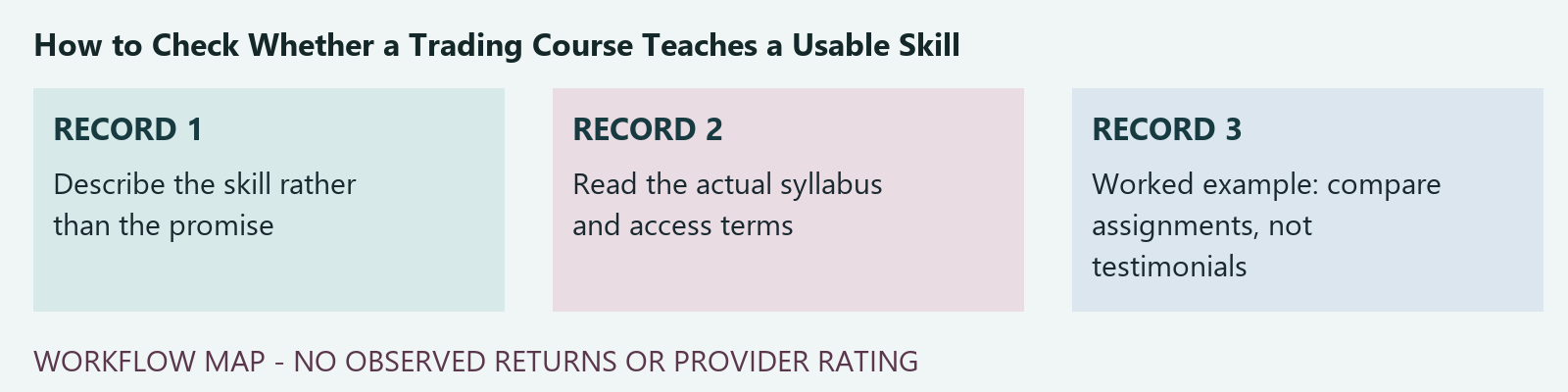
Describe the skill rather than the promise
Replace a vague goal such as becoming profitable with an observable learning task. Examples include identifying an option contract, reconciling fees, translating a written rule into a replay checklist or explaining why a backtest leaks future information. Specify the starting knowledge and the task a learner should perform without copying the instructor. A famous teacher or attractive account screenshot does not tell you whether the material develops that skill. A course can be informative without providing a tested investment advantage.
Read the actual syllabus and access terms
Check module names, prerequisites, format, access duration and what is included in the purchased tier. A free introductory lesson does not establish that every advanced module is free. Published outlines from CME and BabyPips illustrate the value of inspecting topic coverage and access boundaries directly; their inclusion here is not a claim that this publication completed the courses. Save the exact offer and review date, particularly when live sessions, community access, software or later modules require separate payment.
Worked example: compare assignments, not testimonials
Invent two courses teaching order selection. Course A has twelve hours of video and no marked exercise. Course B has four hours of explanation plus an assignment asking the learner to choose between price certainty and execution uncertainty in three scenarios. Neither duration establishes quality. The comparison should ask whether the assignment has a stated rubric, whether feedback explains errors and whether the learner can complete a fresh scenario independently. Do not infer a performance effect or completion rate from this fictional curriculum comparison.
Ask how feedback actually works
Identify who responds, which submissions qualify, the response format and any limits on revisions. An active chat is not necessarily individual instruction. A live demonstration can help explain reasoning but does not replace an assessment of the learner's own work. Request an anonymised sample rubric or published marking example rather than private student financial records. Keep a distinction between a stated feedback service and feedback you personally observed. No paid enrolment, interview or review engagement is asserted by this evaluation protocol.
Budget time, tools and renewal costs
Count practice hours as well as viewing hours. List charting subscriptions, data, software, exams, recurring community fees and renewal terms separately from tuition. The cheapest headline price can conceal a larger total commitment; the longest course can consume time without developing the chosen skill. Decide beforehand what evidence would justify renewing access. SEC order materials are a useful primary mechanism reference for an order lesson, but a course referring to a regulator is not regulator-approved or a substitute for professional advice.
Keep a learning record with a stop decision
Save the objective, baseline exercise, first submission, feedback and a later independent attempt. Assess whether errors decreased on the specified task rather than whether a trade happened to win. Record confusion and unresolved questions so the next learning step has a purpose. If the promised syllabus, access or feedback cannot be confirmed, pause the purchase decision. FTC review guidance provides context for evaluating endorsements and relationships; do not mistake a testimonial collection, affiliate recommendation or editorial score for measured educational outcomes.
Decision record
| Question | Record to retain | Decision boundary |
|---|---|---|
| Objective | A task the learner must complete independently | A return promise is not a learning assessment |
| Offer | Dated syllabus, tier, access and renewal terms | Sample content does not prove full-tier coverage |
| Feedback | Rubric, eligible submissions and response limits | Community activity is not individual marking |
| Outcome | Baseline and later attempts on comparable tasks | One winning trade does not demonstrate learning |
Blank working record
The worksheet contains column headings only. Enter your own dated observations, keep absent evidence marked unknown, and do not treat the file as certification.
 Download worksheet (CSV)
Primary references
- CME: education catalogue
- BabyPips: published course outline and access tiers
- SEC: order types and execution limitations
- FTC: endorsements and reviews
These documents support mechanisms and source definitions, not a tested trading result or a recommendation. Accessed 9 October 2026. The decision workflow and invented examples above are editorial exercises.
Keep reading
Publication methodology | Working glossary | Source and correction policy